
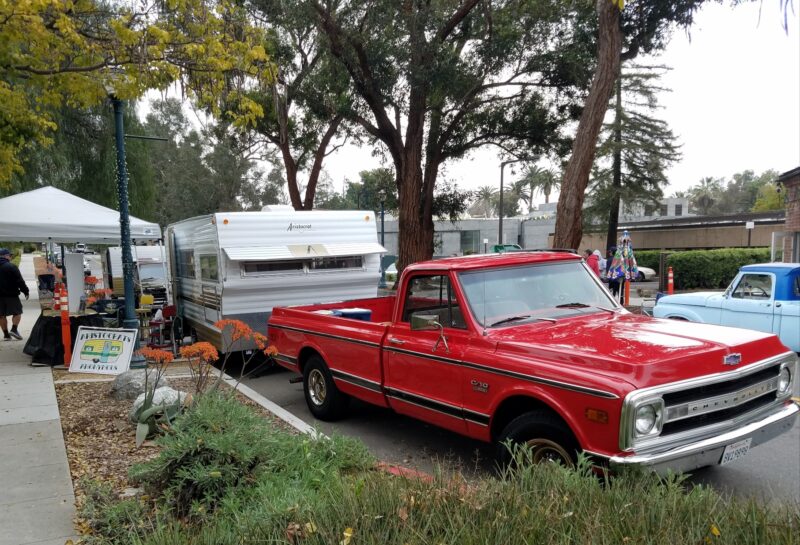
Some may balk at the idea, but the fact is, back then, a car was the best choice for towing a trailer. Pickups were mainly designed for “farm work” and short-range hauling. Packing three kids, the dog, and the wife into a rough-riding pickup that probably had a small 6cyl engine, then hooking up a trailer to head to Yellowstone just wasn’t the best selling point for a truck back then.
If your trailer is under 2000 lbs, most of this is probably unnecessary. Mine is 23′, single axle, and weighs in at 4700 before we load it up. With a trailer this size, you would need to beef things up.
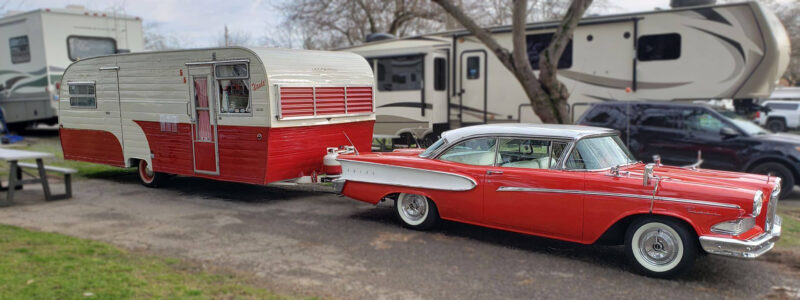
I have owned my 1958 Edsel for over 30 years and have towed with it in the past when it was stock and unrestored, but never dreamed of towing a hefty 60+ yr old trailer with it! I also didn’t want to diminish the originality of the car. I saw a beautiful 1940’s dual-engine Chris Craft (Big Boat!) being towed by an impressive 48 Cadillac once. Wondering, I started looking closely and noticed a couple things. Finally, the owner asked me, “Do you see it yet?” I didn’t! But something wasn’t right. After he gave me a hint..” Look at the cowl.” Wow! Somehow, he put the entire body of the Caddy on a 1994 Chevy ¾ ton pickup! I was amazed at the workmanship! The interior looked bone stock! Now, that cost a LOT of money to do, and if you have that kind of money, skill, and time, have at it. This article will concentrate on those of us that have poured so much of our savings into our beloved trailers, that there isn’t much left to restore or heavily modify a classic car! I’ll use mine as an example a lot since it was restored well over 10 years ago without the intent of pulling a trailer, and what I did to get it ready to do that.
Engine
Most older engines had very good torque at low RPM, which is what you want for towing. Many of today’s engines produce maximum torque at well above 3400 RPM. The thought of pulling a long hill in a low gear at 3500 RPM just bugs me. Too much wear and tear on an engine! I usually tow under 2800 RPM. The engine in my Edsel is one of the things that isn’t original. I had a 1967 Mercury 410 laying around when I restored the car, and it is the same block as the original Edsel was, so it was an easy swap. The original Edsel engine produced 400 ft-lb of torque @ 2900 RPM. Excellent by any standard! The 410 does about 450+ ft-lb @ 2800 RPM, so a marked improvement! Don’t be fooled by “horsepower” ratings. When towing, it’s the torque that counts. There’s an old saying, “Horsepower sells cars, torque wins races!” …and pulls trailers! Also, if you are going to run the original or older engine, something most don’t know is engine oil has changed! They have removed a lot of the additives that were designed for older engines, so special oil or oil additives are a must! ZDDP additive or any oil that says “fortified with zinc” such as Edelbrock or Hemmings motor oil is excellent. I use Royal Purple HPS. It is expensive, but with the strain of dragging around 4700 lbs, it’s worth it! Cooling is another article in itself, so I will just say, aluminum radiators are great and clutch fans are great! One other quick note on cooling, most people don’t realize that “Antifreeze/coolant” really does nothing to help cool your engine. It has very poor heat transfer characteristics. It is mainly for freeze protection and it actually reduces the cooling ability of your entire cooling system! I run about 15% antifreeze and the rest plain water with an additive called “Water Wetter” which significantly offsets the heat transfer issues with antifreeze. The 15% antifreeze helps with corrosion, you don’t want to run straight water! Of course, if you live where it freezes a lot, you would be best to go back to 50/50 and use the water wetter to help with the cooling.
Transmission
I spoke with a couple of vintage transmission builders, and they all say those old automatics will handle a lot, so not much to worry about if you want to run your original transmission. Stay away from two-speed automatics like Powerglide or Ford Two Speed automatics for heavy-duty towing. Two-speed transmissions usually have loose torque converters and can generate a lot of heat. A trans cooler is a must for any automatic transmission! Manual transmission cars will do just fine in most cases. In fact, vehicles with manual transmissions usually have lower rear end gears, which are better for towing.
Rear End
Most older cars with automatic transmissions came with very “long” highway gears in them. This is great for cruising the highway, but for towing, it can put a lot of strain on the engine and trans. There are many calculators online to determine your engine RPM based on speed, rear-end gear ratio, and tire size so you can determine what gears are best for you. Example, the Edsel has 2.91:1 ratio. At 70 MPH it is barely turning over 2200 RPM. At 60-65 MPH, where I like to tow, the engine is running very slow. This is not the ideal situation, considering it is working harder with all the wind load behind me. My goal is to change to 3.25:1 which will make an 11% increase in power to the ground and increase my 65 MPH engine speed to around 2600 RPM. Remember, in an automatic, the slower the RPM, the more the torque converter is “slipping,” which creates heat. With 3.25:1 gears, I will still be able to run down the highway at 70+ and keep the engine under 3000 RPM when not towing. If you change the gear ratio, remember to change your speedometer gear also; otherwise, your speedo will be way off!
Brakes
There are a lot of opinions on what you should do about older brakes on a car. Upgrade to disks, upgrade to a split system, etc. Any brake upgrade is a good idea, especially if your trailer is a small one without brakes. It is a lot harder to stop a 2000 lb trailer with no brakes than it is to stop a 4000 lb trailer with brakes! Upgrading to disks is expensive and, in the case of my car, will not work with the stock wheels, so I decided against it. At the very least, you can upgrade to a “split” system. This is what most modern cars from the ’60s and newer came with. What it does is separates the front and rear brakes, so if you ever have a failure of either, you still have the other. Older cars are a single system, where if you lose one brake line or wheel cylinder, you lose them all! Being a former mechanic and an electronics technician, I ran a specific brake line from the controller to the trailer plug with #12 wire to reduce any resistance. I know, overkill, but that’s just me. A single axle trailer can draw up to 12A of current through the wiring. Double that for a tandem axle if both axles have brakes!
Suspension
With today’s weight distribution systems, we really don’t have too much to worry about. That being said, passenger cars were designed for a smooth ride and can “float” a little when a heavy load is behind them. A simple trick, assuming your car isn’t a station wagon, is to find a set of rear springs off of the same year station wagon. They are usually “stiffer” but won’t really increase the ride height. Stiffer means it takes more weight to move them 1” than the regular spring for that car. For example, on the Edsel, station wagon springs for it take 80 lbs more to move one spring 1” when compared to the standard spring. This will avoid the installation of ugly spring “helpers” or air shocks. Air shocks are OK, but remember, your vintage car wasn’t designed to have that much pressure on the shock mounts. I have heard horror stories about vintage cars from the Midwest, where rust is a significant issue, and air shocks breaking off the mounts and coming up through the floor! I will say I have them on my Edsel, but I never inflate them over 50lbs. No real need with the weight distribution hitch. I just had bad rear springs on the car, and I installed Wagon springs earlier this year and what a difference! Make sure whatever type of shocks you use, they are reasonably stiff. You don’t really want that “boat float” going on with your trailer behind you. The problem I found with air shocks is that they don’t seem to make “stiff” ones for my car, and the “boat float” is much more prominent than with the heavy-duty shocks I had on it before. Since I installed the wagon springs, I may go back to the HD shocks as the air shocks are no longer needed.
Hitch
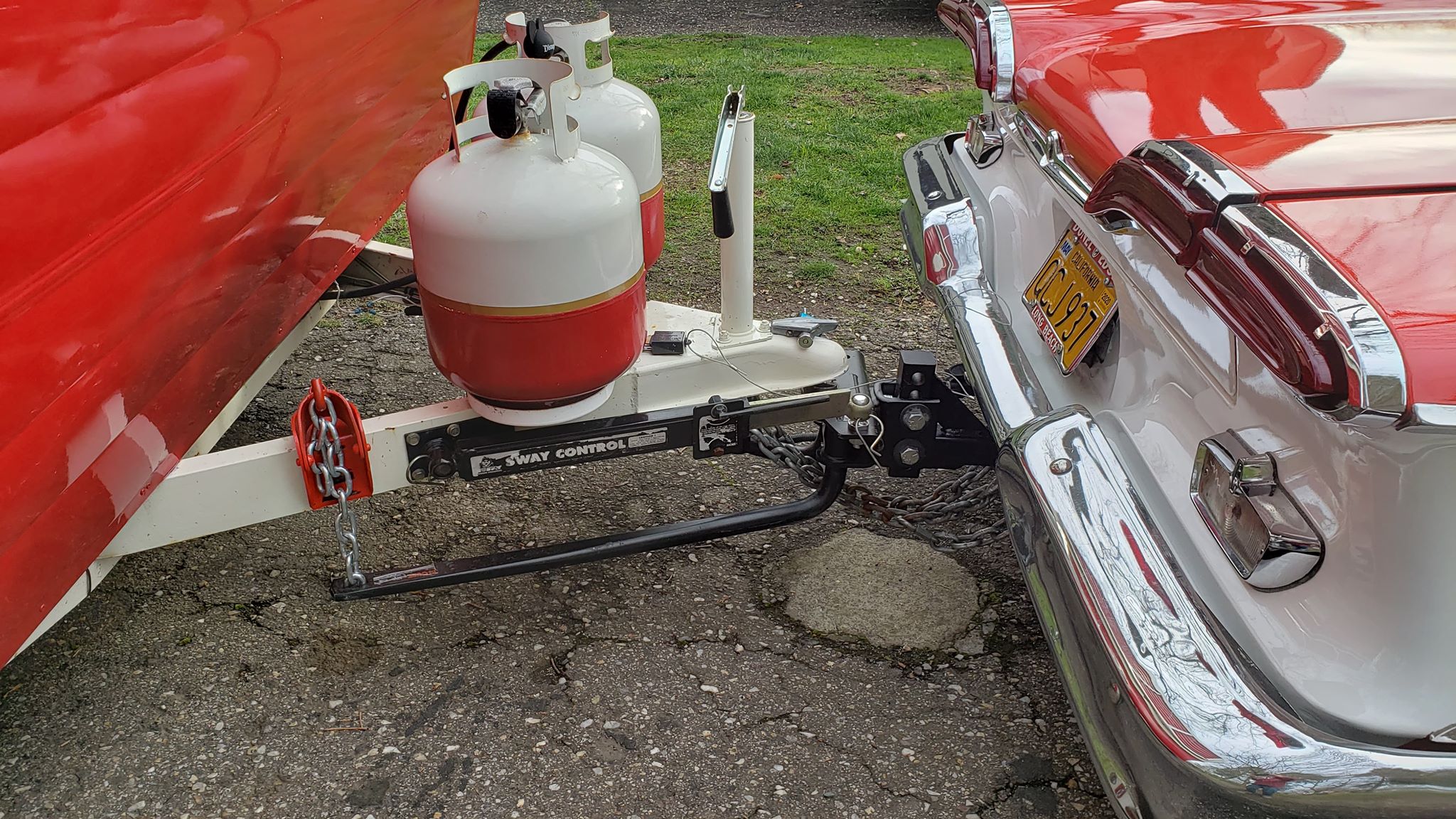
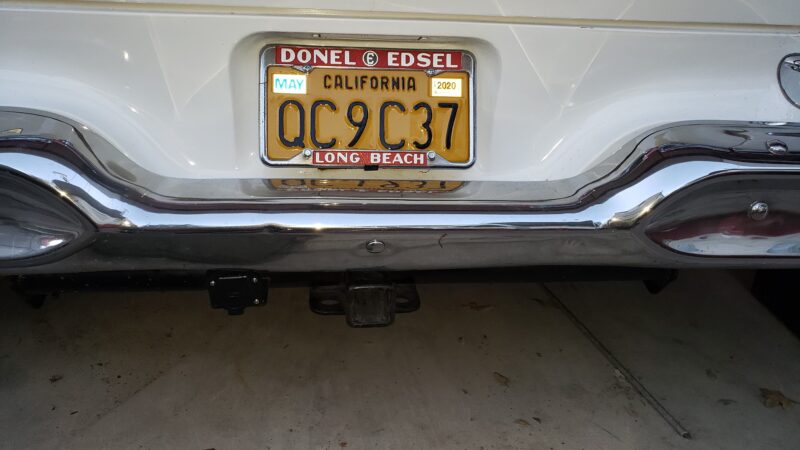
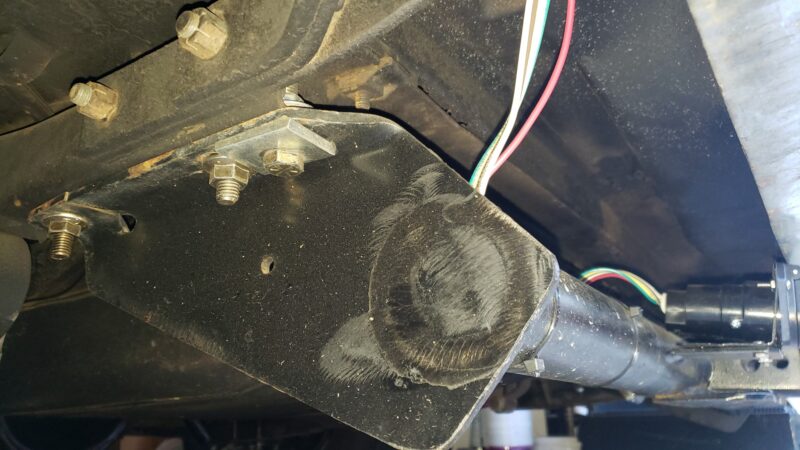
Finding a modern hitch receiver for your vintage car can be a bit difficult. You will probably have to have a custom hitch made. The biggest problem with that is many shops do not want the liability if something goes wrong. You will need a class 3 or 4 receiver hitch. Class 3 will almost always be good enough, unless you are going to pull over 6000 pounds. Before you go looking for a hitch, give your vehicle a proper inspection. If you live in the “rust belt” give it a very good one! If your car has anything more than a little surface rust on the frame, forget it! Not worth the risk. Most older cars have what is called a “boxed frame” where the frame rails are covered on all four sides or “boxed in.” These are very strong and will not be an issue for towing a heavy load. Very old vehicles may have a simple channel frame where the frame was just channel steel, open on one side. These are not the most desirable. It is expensive to have your frame boxed in, but worth it. If you have anything over 3000 lbs, you may want to invest in a weight-distribution hitch. These are the hitch setups you see with the “bars” hanging down under the hitch. What these do is essentially “twist” the car forward by lifting the rear of the vehicle up and forcing some of the tongue weight forward on to the front wheels, kind of like a wheelbarrow does. My trailer has about 500 lbs of Tongue weight, so it was a must! They work great! Some call these “Sway Bars” which is usually inaccurate. Some systems incorporate the sway control into the weight distribution system, some use a separate sway control mechanism that attaches separately. Usually, if the bars are attached with chains, they are NOT sway control, just weight distribution.
I have seen many beautiful setups that have a completely new drive-train under the beautiful exterior. If you have the resources, I would always recommend that route, but if your somewhat of a purist, just be safe about it. I jokingly said many times… “It’s a 60 yr old car pulling a 64 yr old trailer, what could possibly go wrong!” The possibilities are endless, as I found out. Better to know it was my mistake than to think something on the car failed for no reason.
Be prepared, be safe, and enjoy!