
If you have a problem on the road it will most likely be with your tires, bearings or brakes. Most issues can be avoided with proper care and maintenance. After safely jacking up your trailer, follow these steps to locate, identify and repair any issues before they leave you stranded on the side of the road.
BEFORE the wheel is removed:
- SPIN the wheel,
- PULL the break-away pin to see if the brakes lock up the wheel
- LISTEN for any yucky sounds, like a bad bearing – may sound like a grumbling or a rough vibration. You might hear the magnet and shoes dragging against the rotating drum. (A bad bearing will sound different.)
- LOOK at the spinning wheel and tire. Is the rim bent? Does the tire look out of “round?”
- CHECK the tire for sidewall damage, cracks, nails, tread damage, or separations.
- CHECK for wheel bearing play: grab the wheel at the 12 & 6 o’clock position and push/pull away from you. (Repeat for each wheel.)
REMOVE the WHEEL:
NOTE -Sometimes wheels won’t clear the outer skirt area or wheel opening of the trailer when jacked up by the axle. In this case you will have to support or jack up by the trailer frame to get enough clearance in the opening. You may also have to let the air out of the tire.
- REMOVE the wheel and INSPECT the lug nuts and studs for any damaged threads.
- INSPECT the wheel hole opening for damage from lugs being loose.
- DISCARD any worn or damaged wheel hardware.
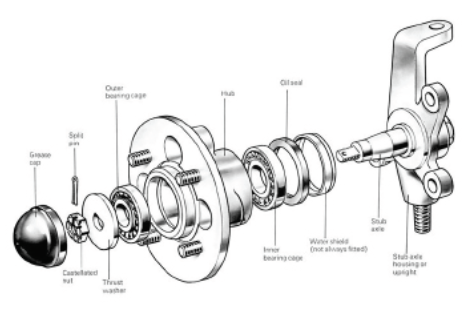
- REMOVE bearing dust cap.
- REMOVE cotter pin and unscrew the castellated nut to end of the spindle, but don’t remove the nut yet. (A castellated nut, also called a castle nut or slotted nut, is a nut with slots (notches) cut into one end).
- GRAB the drum and pull toward you while rotating it. (The drum should pull out to the nut on the spindle.) PUSH drum back on.
- REMOVE the castellated nut, washer, and outer bearing and REMOVE the drum.
- If the drum will not come off, the shoes might be hung up on the inner “lip” of the drum and the shoes will need to be backed off with the brake adjusters.
BRAKE INSPECTION
- REMOVE the brake drum – INSPECT drum for cracks, gouges, and uneven wear. (Brakes not pictured above)
- Are pressed-in lug bolts loose?
- Does the brake shoe have any cracks?
- Is the lining separated from the shoe?
- Does the thickness seem adequate?
- Are there any broken return springs? Magnet wires? Magnet linkages?
- Check and “free-up” brake shoe adjusters as needed.
- GRAB the backing plate and check for looseness. Re-tighten plate as needed.
- If you find damage/wear in any of the above items, you may want to replace the backing plates and brake assembly. Brake drums can be machined at a local shop if need be.
BEARING FUN!
If the trailer hasn’t been used for a period of time, the grease in the bearings and hubs can get hard and lose its lubricating qualities. If you tow a trailer in this condition the metal on metal contact, without sufficient lubrication, may cause friction and heat. This can result in severe damage to the hub, axle flange and other components.
- WIPE out yucky grease from the hub and outer bearing “race”.
- INSPECT outer race for pitting.
- REMOVE grease seal and inner bearing. If you don’t have a Seal Hook – one can be purchased at a local auto parts store.
- INSPECT inner race for pitting.
- CLEAN bearing in solvent (low flammable liquid such as paint thinner or mineral spirits). (USE RUBBER GLOVES! You only have one liver!)
- INSPECT for pitting and galling. Remember when we hand-spun the wheels and listened for bearing noise? You are likely to find a bad bearing on the drum that sounded bad when it was rotated.
- DISCARD any bearings that show any wear. Each bearing, race and grease seal have part numbers by the manufacturer stamped on them. That can be matched up at any good parts store. (Napa has good stuff.) (See next section)
- REPACK the bearings if they look OK.
NOTE: Don’t even think about throwing away any of the old parts until you have installed your new ones. I even keep a set of pre-greased old bearings and a new seal with me on all trips just in case I have a bearing issue on the road. Also – write down the part numbers and keep a copy of the receipts in the trailer for future reference.
REPLACING WHEEL BEARINGS
Get brake spray and blast the shoes and backing plate assembly. Use a drip pan to catch yucky stuff. Blast the inside of the brake drum. DON’T BREATHE FUMES – you only have one brain! The next steps will require a ball peen hammer, drift punch and bearing race driver kit. If you don’t feel comfortable doing the bearing replacement, a local machine shop will swap out the races for a nominal fee. ($25?)
Drive out the old races. Lay down drum with studs facing up. Using drift punch drive inner race out evenly until the race drops out of drum. You can see the backside of the race from the outside looking through the dust cap opening. Make sure you are hitting the race and don’t hit the cast iron drum! Flip the drum over. Place on 2×4 or 2×6 blocks with the wheel studs on the blocks. Drive out the outer race the same way you did the inner race. The races must be driven out and installed EVENLY otherwise they will be cock-eyed and bind up. The races will take some force to drive out. If they just fall out… that’s not good! Inspect the hub where the bearing sits for galling and wear. It may have seized at one time, and may have spun, damaging the hub. If this is the case the hub drum should be discarded!
Drive in new races. Pick out a driver that is slightly smaller than the race you are driving in. Clean the hub and install the race “numbers down” and “taper up.” I use a hammer only until the race is started then I switch to the driver. Send race home evenly until seated. You will hear when it seats – it will sound different. Then use what God gave you and look at your work. Can you see that the race is at the bottom of the hub? Look from the other side as well. Drive home the other race just as you did the first – CHECK YOUR WORK.
PACKING THE WHEEL BEARINGS
Wearing rubber gloves, repack your bearings as follows. You can pack by hand or buy a bearing packer at a parts store. Use high-quality speed and temp-rated wheel-bearing grease.
- Start by JAMMING grease into the bearing. Rotating the bearing as you go. When you think you’re done… do it again!
- INSTALL inner bearing into the hub. Take new grease seal and pack the backside of the seal with grease. This will keep the micro-spring that keeps the tension on the seal lip from popping off when you install it.
- USING one of the bearing drivers that is bigger in diameter than the seal – use the flat side of the driver to tap down the seal flush with the top of the hub.
- INSPECT the spindle. Wipe off the old grease and check where the inner and outer bearings sit. They should slide off and on by hand.
- CHECK for galling and/or seizing on the inner race to spindle area. If no issue is found they it is time to re-assemble.
- MAKE sure you use brake spray on the shoes and backing plate. Make sure there is no grease on or on the inside area of the drum especially where the brake shoes contact.
- SLIDE the drum onto the spindle until it stops. Slide on pre-packed outer bearing, washer and install castellated nut. Tighten the nut as you rotate the drum. If drum binds up and does not rotate freely… take back apart and find your mistake.