
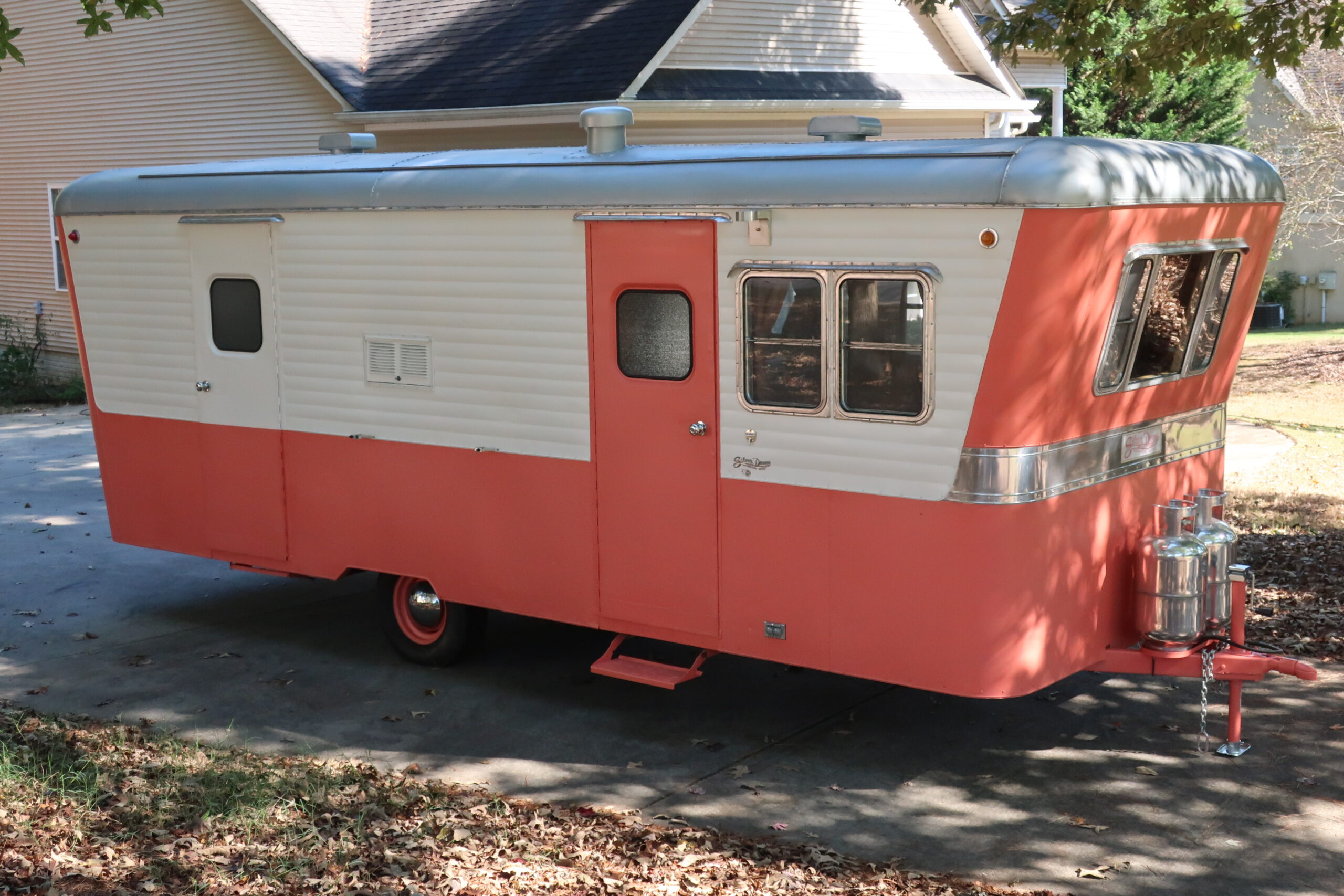
About eight years ago, I restored a 1964 Shasta Astroflyte. As much as we loved it, the trailer started to feel a little tight for our growing family of four. We began looking for a larger vintage trailer to restore and camp in—something with mid-century modern design, a full bathroom, and a bedroom that could be closed off, creating two separate living spaces.
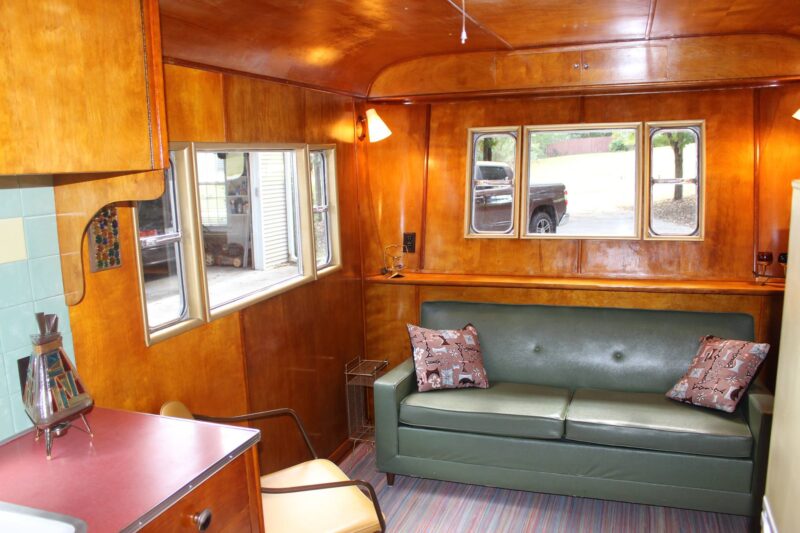
That checklist led us in one clear direction: a vintage mobile home. We wanted to keep it relatively short so it would still fit into rustic campsites and smaller campgrounds where a 40-footer just wouldn’t work.
One day, while scrolling Craigslist, we found the perfect match—a 1955 Silver Dome Heritage 24. It checked every box and had a bold trapezoid shape that absolutely screamed mid-century modern. The trailer belonged to Johnny Agnew in Los Angeles. I gave him a call… only to find out it had sold the day before. Back to the drawing board.

Then something unbelievable happened. Just a few days later, another Silver Dome Heritage 24 appeared on Craigslist—this time in Massachusetts. These may be the only two in existence. It felt like divine guidance.
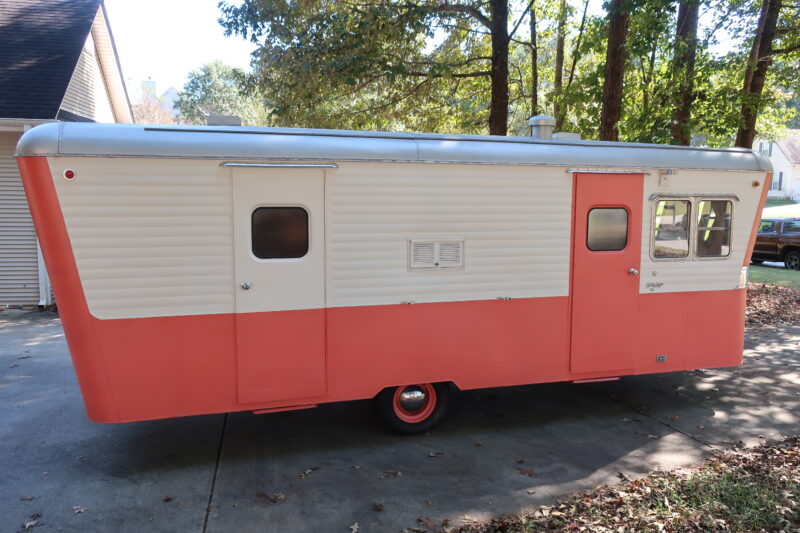
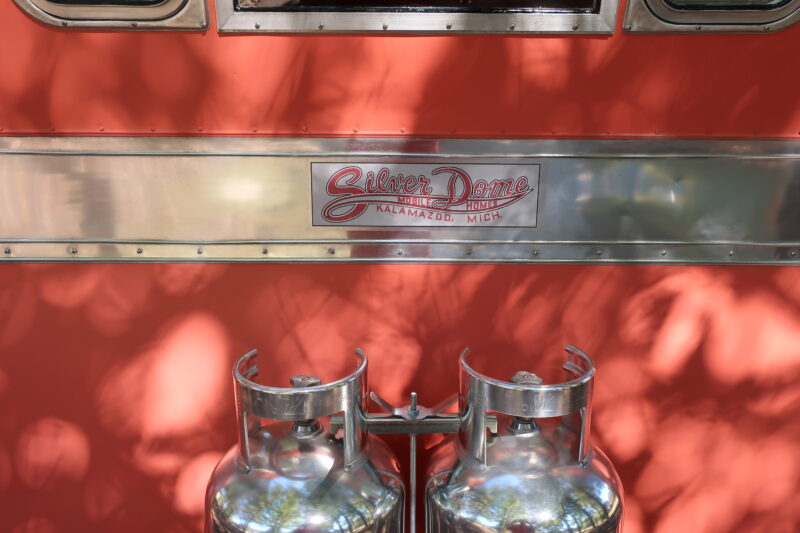
The 1955 and 1956 Silver Dome Heritage trailers look nearly identical from the outside, with only slight differences in the interior layout. The Heritage line was offered in seven lengths, up to 50 feet, with the 24-foot model being the smallest. It came only as a single-axle trailer, while the 27-foot model could be ordered with a single or dual axle, and anything 31 feet and longer came standard with dual axles. As far as I know, 1955 and 1956 were the only years to feature the trapezoid shape—the 1954 models were more “bread-loaf” in design, and by 1957 the look had shifted to a more modern style. These trailers were built in Kalamazoo, Michigan, as a spin-off of the larger Kozy Coach company, which ended production in 1961.

We had the Silver Dome shipped from Massachusetts to Sharpsburg, Georgia. As is often the case with sight-unseen purchases, it was rougher than expected. Water damage required a complete interior gut. The chassis and tongue had through-rust, so I welded angle-iron reinforcements along the main rails, cut the original A-frame back about two feet, and welded on a new one.
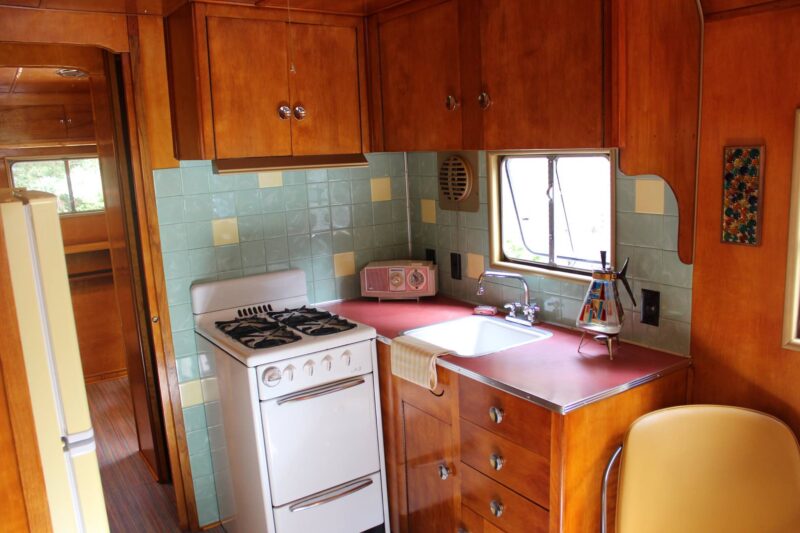
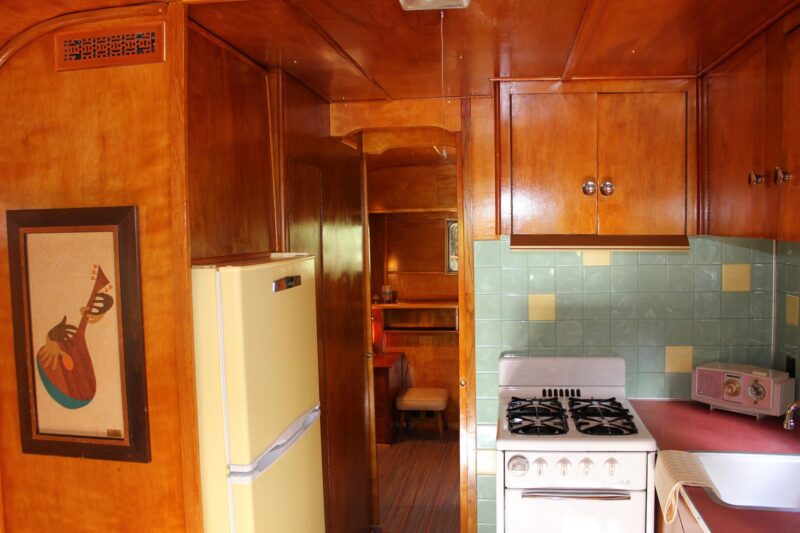
About two-thirds of the original wood remains, along with all of the cabinetry. I boarded over the floor—after cutting out several damaged sections—and installed Forbo Marmoleum sheet flooring. The birch wood interior was finished with amber shellac. The restoration took about four years, much longer than the Shasta. Kids tend to need more attention as they get older.
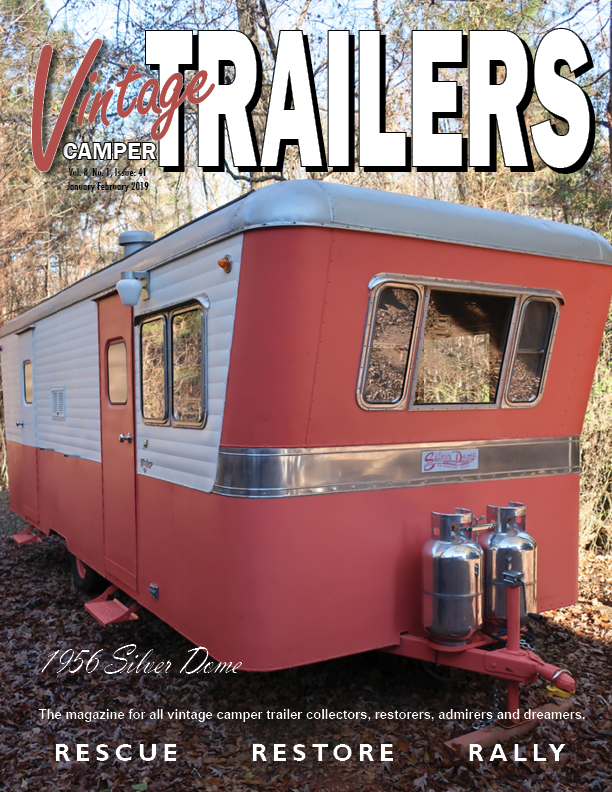
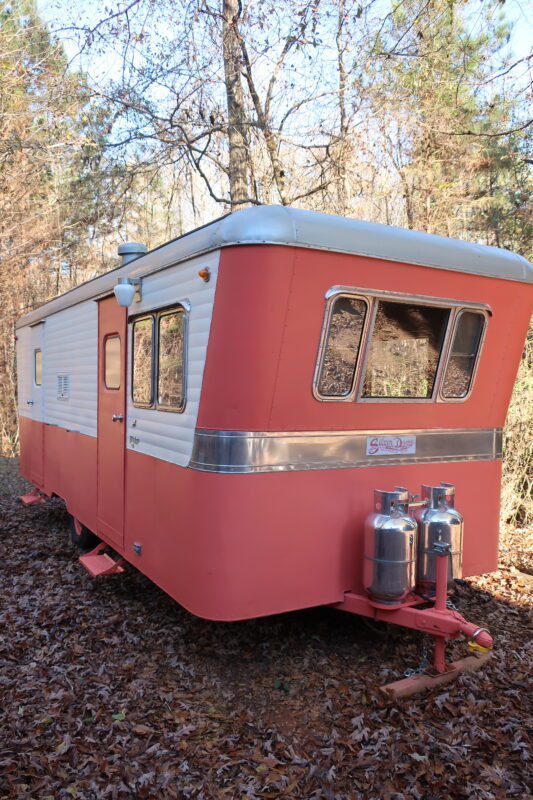
I’ve always loved mid-century pastels, especially coral. We own so many turquoise vintage items that I’m honestly a little “turquoised out.” The exterior colors are Salmon Coral (a special-order 1964 Ford Galaxie color) and Dover White, both very close to original Silver Dome production colors. Johnny’s 1955 Heritage was also coral and white. When I sanded our trailer down, I discovered the original paint had been white and a very dark turquoise—an interesting choice, but not one that felt especially happy.

One of the most meaningful moments of the restoration came during demolition. Behind the refrigerator, I discovered a drawing of an airplane, clearly made by a child, complete with a name. On a whim, I sent private Facebook messages—about fifty of them—to people in Massachusetts with that name, including a photo of the drawing.
Then—BINGO. One woman replied and said she had drawn it.
We exchanged messages, and she told me the trailer had belonged to her grandmother and had spent many years in a campground. She visited it during summers and had countless fond memories playing inside. She also shared that the campground eventually closed and she didn’t know what became of the trailer afterward.
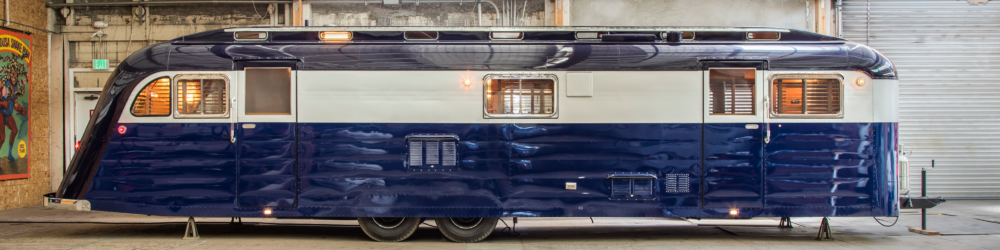
Later, while searching online for vintage mobile home photos, I stumbled across an image of a Silver Dome Heritage 24. I was stunned—it was our trailer. Judging by the setting, the photo was likely taken after its campground days, in an urban environment. Seeing that image felt like the final piece of a story that had come full circle.
This Silver Dome didn’t just get restored—it came home.